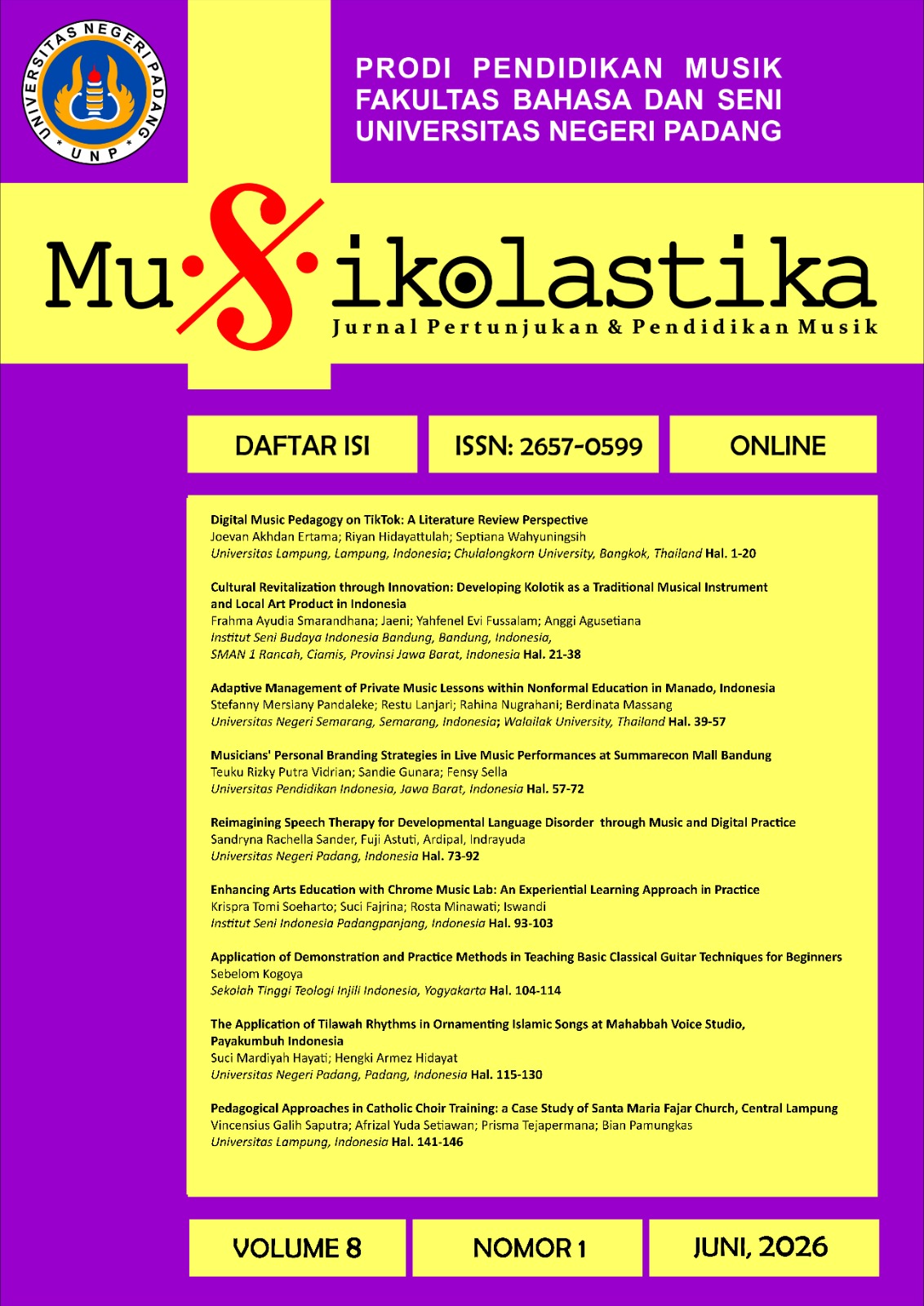
The Application of Tilawah Rhythms in Ornamenting Islamic Songs at Mahabbah Voice Studio, Payakumbuh Indonesia
DOI:
https://doi.org/10.24036/musikolastika.v8i1.404Keywords:
analysis, usage, recitation rhythm, ornamentation, islamic songAbstract
Objective: This study aims to analyze the use of Tilawah rhythms as ornamentation in Islamic songs, specifically in the song Bii Rasulillah at Mahabbah Voice Studio, Payakumbuh, focusing on musical characteristics, vocal techniques, and the expression of religiosity. Method: The study employed a qualitative approach with a content analysis method. The researcher served as the primary instrument, supported by writing tools and a camera to record audio and visual data. Data were collected through direct observation, literature review, interviews, and analysis of audio-video recordings of Bii Rasulillah. Data analysis followed steps of data collection, comprehension, coding, theme identification, and drawing conclusions. Results and Discussion: Findings indicate that Tilawah rhythms possess distinctive musical characteristics, structured melodic patterns, and diverse emotional nuances, supported by vocal techniques such as hight chest voice and proper breath control. Ornamentation in Bii Rasulillah includes the use of Bayyati, Hijaz, and Nahawand rhythms, integrating Tilawah and singing techniques in terms of melody inflection, dynamics, and vocal expression, producing a unique and religiously nuanced vocal character. Conclusion: This study confirms that integrating Tilawah rhythms as ornamentation in Islamic songs enriches singing techniques and shapes expressive, religiously inspired vocal performance, highlighting the potential of Tilawah as an aesthetic resource in contemporary Islamic music education.Downloads
References
Abdelmonem, M., & Khalil, E. (2022). Beautifying the voice in reciting the Qur ’ an and its relationship to musical maqamat : an analytical study. Qeios, 1–8. https://doi.org/https://doi.org/10.32388/N9NRVR
AL-HAFI, A. (2023). Transmisi Ayat Al-Qur`An Dalam Tradisi Muqaddam Oleh Teungku Chik Di Pasi Kepada Masyarakat Petani Di Gampong Waido, Kabupaten Pidie, Aceh. Pascasarjana Universitas Ptiq Jakarta.
Al-Khatib, A. (2022). Tilawah: The Aesthetics of Quranic Recitation. International. Journal of Islamic Music Studies.
Anwar. (2021). Maqamat dalam Tilawah Al-Qur’an dan Estetika Suara Qari. CV Media Qurani.
Elo, S., Kääriäinen, M., Kanste, O., & Pölkki, T. (2014). Qualitative Content Analysis : A Focus on Trustworthiness. SAGE Journals, 4(1). https://doi.org/10.1177/2158244014522633
Fadel, E. M. (2018). The Influence of the Iraqi Maqam in the Recitation of Hafiz Khalil Ismail. Al Academi, IRAQI Academic Scientific Journals, 90, 409–422. https://doi.org/https://doi.org/10.35560/jcofarts90/409-422
Faiza. (2023). Peran Ornamentasi dalam Seni Tilawah. Jurnal Seni Islam, 4(2), 45–53., 4(2), 45–53.
Hidayatullah, R. (2022). Vokal Dasar. Lakesha. http://repository.lppm.unila.ac.id/54309/1/buku vokal dasar.pdf
Ishak, M., & Sit, M. (2017). PELAKSANAAN PROGRAM TILAWAH ALQURAN DALAM MENINGKATKAN KEMAMPUAN MEMBACA ALQUR ’ AN SISWA DI MAS AL MA ’ SUM STABAT. 1(4), 602–618.
Khatami Ayu Rini, dkk. (2025). Maqamat sebagai Pola Ornamentasi dalam Musik Islami Modern. Jurnal Musik Dan Dakwah, 2(1), 55–67., 2(1), 55–6, 55–67.
Kristina Nelson. (1985). The Art of Reciting the Qur’an (Ethnomusicology (1989) 33(3) 522 (ed.)). American University in Cairo Press. https://doi.org/DOI: 10.2307/851774
Kurnianto, A. D. I., Ushuluddin, F., Humaniora, D. A. N., Islam, U., & Walisongo, N. (2022). SADZILIYAH DI PONDOK PESANTREN KYAI PARAK PARAKAN , TEMANGGUNG ( Studi Living Hadits ). UIN Walisongo Semarang.
Pradopo, R. (2020). Teori dan Estetika Suara dalam Seni Musik. Gadjah Mada University Press.
PRATAMA, F. S. (2023). DARI SUFISTIK KE POP RELIGI : SEJARAH TRANSFORMASI MUSIK DALAM PERADABAN ISLAM From Sufism to Religious Pop : The History of Music Transformation in the Islamic. Al-Tsaqafa: Jurnal Ilmiah Peradaban Islam, 20(1), 1–13. https://doi.org/10.15575/al-tsaqafa.v20i1.
Pratama, Z. W., Setyoko, A., & Purwanti, P. (2023). Bedandeng Kutai: Ornamentasi Melismatis Dalam Bedandeng Kutai. Keteg : Jurnal Pengetahuan, Pemikiran Dan Kajian Tentang Bunyi, 22(2), 109–117. https://doi.org/10.33153/keteg.v22i2.4538
Qonita, M., Hilmy, F., Khusna, S. L., Apriliani, J., Fauzi, R. A., & Najih, M. (2024). Strategi Pengembangan Seni Rebana Desa Sumberarum Melalui Pelatihan Media Branding. Jurnal Pemberdayaan Masyarakat, 3(2), 76–84. https://doi.org/10.46843/jmp.v3i2.307
Rasiah, J., Cummings, G. G., Gruneir, A., Oelke, N. D., Estabrooks, C., & Holroyd-Leduc, J. (2020). Prefrailty in older adults: A concept analysis. International Journal of Nursing Studies, 108, 103618. https://doi.org/https://doi.org/10.1016/j.ijnurstu.2020.103618
Razzak, R. A. (2021). Makna Semiotik Kesenian Buncis Angklung bagi Masyarakat Desa Tanggeran di Banyumas. 3(1), 38–51.
Rismawan, S. A. (2014). Ekspresi Musikal Dan Fungsi Musik Saestu Band Reggae Bagi Masyarakat Kota Semarang. JURNAL SENI MUSIK, 3(1), 1–7.
Seran, J. O. (2025). Pengembangan Teknik Ornamentasi Melodis Dan Ritmis Pada Vokal Solo Sebuah Kajian Praktis Melalui Pembelajaran Di Kelas Ix Smp St. Yoseph Naikoten. Jurnal Ilmiah Kajian Multidisiplin, 9(11)., 9(11).
Sugiyono. (2019). Metode Penelitian Kuantitatif, Kualitatif, dan R&D. Alfabeta.
Suryati. (2018). Ornamentasi Seni Baca Al-Qur ’ an dalam Musabaqoh Tilawatil Qur ’ an sebagai Bentuk Ekspresi Estetis Seni Suara. Resital: Jurnal Seni Pertunjukan, 17(2), 67–74.
Suryati, S., Simatupang, G. R. L. L., & Ganap, V. (2018). Ornamentasi Seni Baca Al-Qur’an dalam Musabaqoh Tilawatil Qur’an sebagai Bentuk Ekspresi Estetis Seni Suara. Resital: Jurnal Seni Pertunjukan, 17(2), 67–74. https://doi.org/10.24821/resital.v17i2.2219
Wahyudi, I., & Sutanto, T. S. (2013). Kesenian Gembyung Di Padepokan Dangiang Dongdo Kabupaten Subang. Swara: Jurnal Antologi Departemen Pendidikan Seni Musik FPSD UPI, 1(3), 1–11.
Yaqin, H. (2018). Pemaknaan Shalawat;Pandangan Majelis Dzikir Haqqul Yaqin. Tahdis, 9(2), 180–199. https://doi.org/https://doi.org/10.24252/tahdis.v9i2.12478
Downloads
Published
How to Cite
Issue
Section
License
Copyright (c) 2026 Suci Mardiyah Hayati, Hengki Armez Hidayat

This work is licensed under a Creative Commons Attribution-NonCommercial-ShareAlike 4.0 International License.
Authors who publish with this journal agree to the following terms: Authors retain copyright and grant the journal right of first publication with the work simultaneously licensed under a Creative Commons Attribution-ShareAlike 4.0 International License. that allows others to share the work with an acknowledgement of the work's authorship and initial publication in this journal.
Authors are able to enter into separate, additional contractual arrangements for the non-exclusive distribution of the journal's published version of the work (e.g., post it to an institutional repository or publish it in a book), with an acknowledgement of its initial publication in this journal. Authors are permitted and encouraged to post their work online (e.g., in institutional repositories or on their website) prior to and during the submission process, as it can lead to productive exchanges, as well as earlier and greater citation of published work (See The Effect of Open Access).

This work is licensed under a Creative Commons Attribution-ShareAlike 4.0 International License.

.png)




1.png)