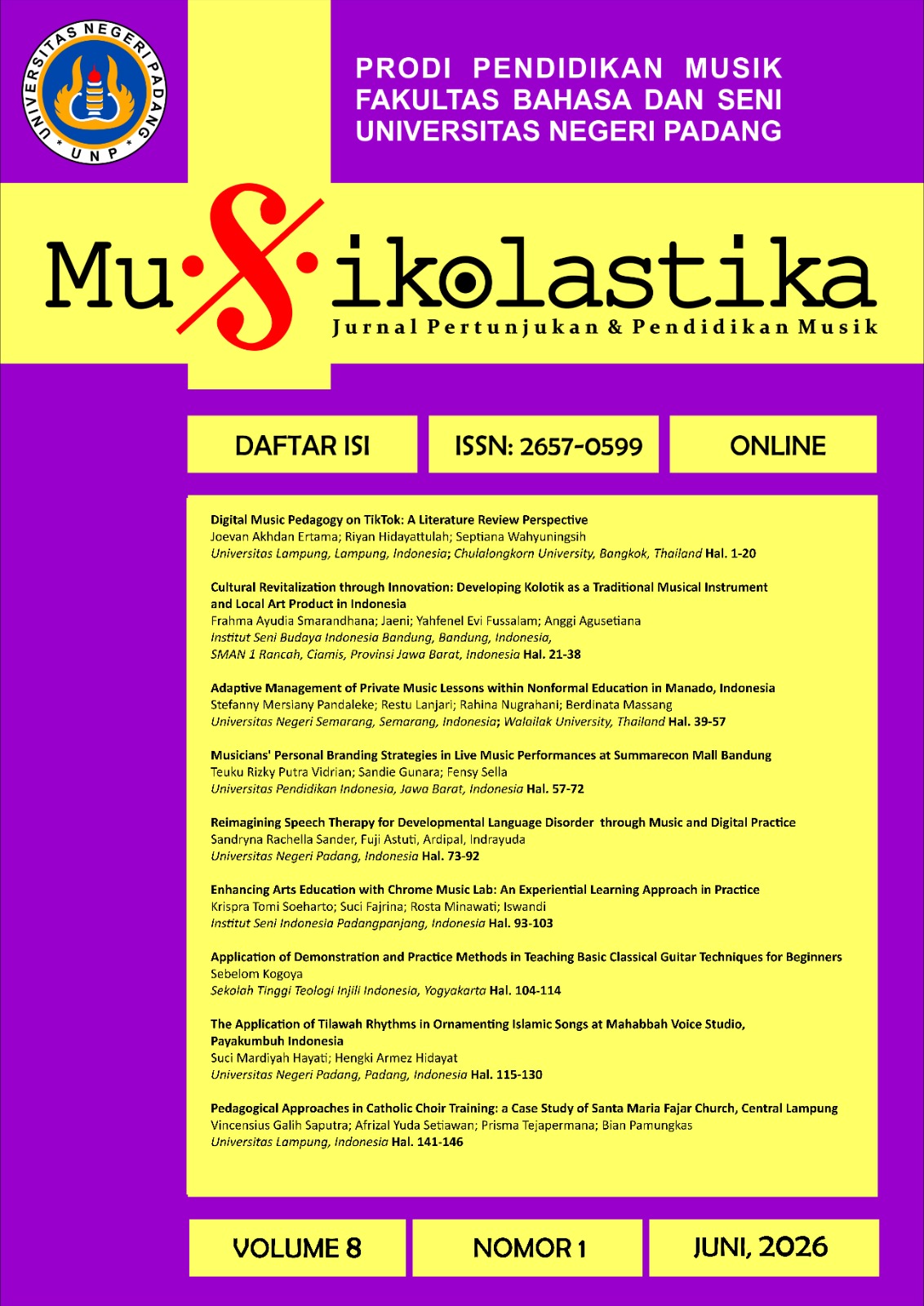
Reimagining Speech Therapy for Developmental Language Disorder through Music and Digital Practice
DOI:
https://doi.org/10.24036/musikolastika.v8i1.374Keywords:
speech therapy, developmental language disorder, nursery rhyme, bingo, professional digital platformsAbstract
Purpose: This study aims to examine the representation of speech therapy practices for children with Developmental Language Disorder (DLD) through the use of the nursery rhyme “Bingo”, as manifested in professional digital interactions. Methods: The study employs a descriptive qualitative approach by examining narrative, comments, and professional reflections shared by speech therapist, support teacher, and special education practitioner on professional digital platforms. This approach enables an in depth understanding of the experiences, strategies, and practical meanings that envolve within the digital ecosystem. Results and Discussion: Findings reveal that the nursery rhyme “Bingo” is represented as an applicable, flexible, and easily adaptable therapeutic medium in field practice. The song’s characteristics as repetitive lyrics, a simple rhythmic structure, and the integration of body movements are perceived as effective in stimulating both receptive and expressive language abilities in children with DLD. Professional digital interactions function not only as spaces for sharing experiences but also as sources of collective practical knowledge that complement theoretical perspectives in speech therapy. Conclusion: The use of the nursery rhyme “Bingo” in speech therapy for children with DLD can be understood as an experience-based professional practice that develops collaboratively through digital platforms. Professional digital interactions play a crucial role in strengthening the dissemination of effective practices and supporting the development of contextual, adaptive, and sustainable speech therapy approaches.Downloads
References
Agustina, R., & Azizah, N. (2025). Enhancing Language Development through Multisensory Media Interventions. Journal of Innovation and Research in Primary Education, 4(4), 2536–2546. https://doi.org/10.56916/jirpe.v4i4.2363
Aini, Z., & Andita, S. P. (n.d.). THE ROLE OF SONG IN SUPPORTING LANGUAGE DEVELOPMENT OF PRE-SCHOOL CHILDREN WITH LANGUAGE DELAYS: A SYSTEMATIC REVIEW (Vol. 83, Issue 1).
Aniruddh Patel. (2009). Review: Music, Language, and the Brain , by Aniruddh Patel . Music Perception, 26(3), 287–288. https://doi.org/10.1525/mp.2009.26.3.287
Arbib, M. A. (2013). Language, Music, and the Brain: A Mysterious Relationship.
Ash-Shiddiqi, H., Sinaga, R. W., & Audina, N. C. (2025). Kajian Teoritis: Analisis Data Kualitatif (Vol. 3, Issue 2).
Attwell, G. A., Bennin, K. E., & Tekinerdogan, B. (2022). A Systematic Review of Online Speech Therapy Systems for Intervention in Childhood Speech Communication Disorders. In Sensors (Vol. 22, Issue 24). MDPI. https://doi.org/10.3390/s22249713
Bishop, D. V. M. (2014). Ten questions about terminology for children with unexplained language problems. In International Journal of Language and Communication Disorders (Vol. 49, Issue 4, pp. 381–415). Wiley-Blackwell Publishing Ltd. https://doi.org/10.1111/1460-6984.12101https://doi.org/10.1111/1460-6984.12101
Bishop, D. V. M., Snowling, M. J., Thompson, P. A., Greenhalgh, T., Adams, C., Archibald, L., Baird, G., Bauer, A., Bellair, J., Boyle, C., Brownlie, E., Carter, G., Clark, B., Clegg, J., Cohen, N., Conti-Ramsden, G., Dockrell, J., Dunn, J., Ebbels, S., … Whitehouse, A. (2016). CATALISE: A multinational and multidisciplinary Delphi consensus study. Identifying language impairments in children. PLoS ONE, 11(7). https://doi.org/10.1371/journal.pone.0158753
Bolduc, J., & Lefebvre, P. (2012). Using Nursery Rhymes to Foster Phonological and Musical Processing Skills in Kindergarteners. Creative Education, 03(04), 495–502. https://doi.org/10.4236/ce.2012.34075
Calabrese, P., Hedger, N., Pritchard, K., Stojanovik, V., & Pagnamenta, E. (2025). Word learning in children with developmental language disorder: A meta-analysis testing the encoding hypothesis. Journal of Memory and Language, 145. https://doi.org/10.1016/j.jml.2025.104678
Cheryl Ramadhany, L., Nur Khalifah, A., Zaezori, A., & Syarif Hidayatullah Jakarta, U. (2024). Implementasi Metode Bernyanyi dalam Mengembangkan Kemampuan Berbicara Anak Usia Dini. In Indonesian Journal of Early Childhood: Jurnal Dunia Anak Usia Dini (Vol. 6). http://jurnal.unw.ac.id/index.php/IJEC
Christina, Y. (2023). The Effectiveness of Nursery Rhymes Media to Improve English Vocabulary and Confidence of Children (4-5 Years) in Tutor Time Kindergarten. In Journal of Education Research (Vol. 4, Issue 3).
Conti-Ramsden, G., & Durkin, K. (2016). What Factors Influence Language Impairment? Considering Resilience as well as Risk. Folia Phoniatrica et Logopaedica, 67(6), 293–299. https://doi.org/10.1159/000444750
Dewey, J. (1934). ART AS EXPERIENCE.
Febriana, F., 1, J., Pali, A., & Henakin, S. T. (2025). Nursery Rhymes dalam Peningkatan Keterampilan Listening Peserta Didik. 9. https://doi.org/10.31004/basicedu.v9i5.10614
Fhadilla, G. I., Setiawan Djuharie, O., & Suswanto, D. (n.d.). VOCABULARY ACQUISITION THROUGH NURSERY RHYMES BY AL-AZHAR KINDERGARTEN CHILDREN (Vol. 22, Issue 2).
Goswami, U., Power, A. J., Lallier, M., & Facoetti, A. (2014). Oscillatory “temporal sampling” and developmental dyslexia: Toward an over-arching theoretical framework. In Frontiers in Human Neuroscience (Vol. 8, Issue November). Frontiers Media S. A. https://doi.org/10.3389/fnhum.2014.00904
Hadrayani, E., Diana, N., & Purnama, N. (2024). Jurnal Gema Keperawatan |Volume 17|Nomor 2| 62 Eka Hadrayani, Muthahharah, Nadila Diana, Nahdah Purnama (Vol. 17, Issue 2).
Hasanah, U., Kamila, F., Wulandari, R., & Caesar Rahmawati Khoirina, R. (2025). Enhancing Children’s Creativity Through Art-Based Learning in Early Childhood: A Strategy to Stimulate Gross and Fine Motor Development. Nak-Kanak: Journal of Child Research, 2(1), 17–22. https://doi.org/10.21107/njcr.v2i1.138
Hasbullah Rumbaroa, R. (2020). URGENSI MEMAHAMI PERKEMBANGAN BAHASA ANAK (URGENCY UNDERSTANDING CHILDREN’S LANGUAGE DEVELOPMENT). In Budaya dan Sastra (Vol. 2, Issue 2).
Hutchins, C., & Beth Schmitt, M. (2024). Group Size 1 Group Size: An Active Ingredient of School-Based Language Therapy.
Leinweber, J., Alber, B., Barthel, M., Whillier, A. S., Wittmar, S., Borgetto, B., & Starke, A. (2023). Technology use in speech and language therapy: digital participation succeeds through acceptance and use of technology. Frontiers in Communication, 8. https://doi.org/10.3389/fcomm.2023.1176827
Lin, Y., Lemos, M., & Neuschaefer-Rube, C. (2022). Digital Health and Learning in Speech-Language Pathology, Phoniatrics, and Otolaryngology: Survey Study for Designing a Digital Learning Toolbox App. JMIR Medical Education, 8(2). https://doi.org/10.2196/34042
Liu, K. C., Huang, J. J., Pei, Y. C., Huang, S. C., & Chung, C. Y. (2025). The improvement following speech and language therapy in children with mixed receptive-expressive language disorder across different age groups: A retrospective study. Pediatrics and Neonatology. https://doi.org/10.1016/j.pedneo.2025.03.007
Mangunsong, R. R. D., Sutanto, A. V., & Sudarman, S. (2024). Factors Influencing Language Development in Preschool Children in Karanganyar Regency, Central Java. International Journal of Public Health Excellence (IJPHE), 4(1), 260–268. https://doi.org/10.55299/ijphe.v4i1.1125
Martínez-Castilla, P., Calet, N., & Jiménez-Fernández, G. (2023). Music skills of Spanish-speaking children with developmental language disorder. Research in Developmental Disabilities, 140. https://doi.org/10.1016/j.ridd.2023.104575
Mutoharoh, Q., Triningsih, R. W., & Aryani, H. R. (2022). MUSIK SEBAGAI STIMULASI PERKEMBANGAN BAHASA PADA ANAK USIA DINI : LITERATURE REVIEW Music As A Stimulation Of Language Development In Early Childhood : Literature Review (Vol. 11, Issue 1).
Ormieres, C., Lesieur-Sebellin, M., Siquier-Pernet, K., Delplancq, G., Rio, M., Parisot, M., Nitschké, P., Rodriguez-Fontenla, C., Bodineau, A., Narcy, L., Schlumberger, E., Cantagrel, V., & Malan, V. (2025). Deciphering the genetic basis of developmental language disorder in children without intellectual disability, autism or apraxia of speech. Molecular Autism, 16(1). https://doi.org/10.1186/s13229-025-00642-8
Paquette, K. R., & Rieg, S. A. (2008). Using music to support the literacy development of young english language learners. Early Childhood Education Journal, 36(3), 227–232. https://doi.org/10.1007/s10643-008-0277-9
Pino, M. C., Giancola, M., & D’Amico, S. (2023a). The Association between Music and Language in Children: A State-of-the-Art Review. In Children (Vol. 10, Issue 5). MDPI. https://doi.org/10.3390/children10050801
Rahmaningrum, C., Terapi Wicara, J., & Kesehatan Kemenkes Surakarta, P. (n.d.-b). PENGARUH NURSERY RHYMES TERHADAP KEMAMPUAN KOSAKATA RESEPTIF PADA ANAK USIA PRASEKOLAH DI TK NEGERI PEMBINA TRENGGALEK.
Register, D. M., Fueyo, V., Madsen, C. K., Member, C., & Gregory, D. G. (n.d.). SCHOOL OF MUSIC THE EFFECTS OF LIVE MUSIC GROUPS VERSUS AN EDUCATIONAL CHILDREN’S TELEVISION PROGRAM ON THE EMERGENT LITERACY OF YOUNG CHILDREN Outside Committee Member.
Sefy, S. A. S., & Dorlina Simatupang, N. (2022). Pengaruh Aktivitas Bernyanyi Terhadap Perkembangan Bahasa Anak di TK Kurnia Putra. Jurnal Pelita PAUD, 6(2), 239–247. https://doi.org/10.33222/pelitapaud.v6i2.1896
Surismiati. (n.d.). MODUL PSIKOLINGUISTIK FIX.
Sutton, S., Vines, J., Mcnaney, R., Webster, M., Olivier, P., & Lab, C. (n.d.). Trust and Evidence in an Online Community of Speech and Language Therapists: The Case of iPad Use. http://www.dailymail.co.uk/news/article-
Tulas‘un, L., & Winarni, I. (2025). Analisis Perkembangan Bahasa Anak dalam Berkomunikasi (Studi pada Anak Usia SD/MI terhadap Perkembangan Bahasa). Jurnal Penelitian Ilmu Sosial Dan Eksakta, 4(2), 162–172. https://doi.org/10.47134/trilogi.v4i2.1549
Ulwiyah, I. (n.d.). STIMULASI KECERDASAN LINGUISTIK VERBAL ANAK USIA DINI MELALUI VARIASI LAGU. In JECIE (Vol. 6).
Usman, R., Ningsih, N., Tinggi Ilmu Manajemen LPI Makassar, S., Bung No, J., Jaya, T., Tamalanrea, K., Makassar, K., Selatan, S., Dahlan Sinjai, A., Sultan Hasanuddin No, J., Sinjai Utara, K., & Sinjai, K. (2024). The Use Of Nursery Rhymes In Improving The Preschool Pupils’ Vocabulary In Bambini School. Journal on Education, 06(02), 13363–13373.
Utami, H. D. (2025). STIMULASI KEMAMPUAN BERBICARA ANAK USIA 4-5 TAHUN DENGAN METODE BERNYANYI DI TK SANTA LUSIA NYARUMKOP SINGKAWANG TIMUR. 3, 178–192.
Virag, B., Crişan-Vida, M., Dughi, T., & Stoicu-Tivadar, L. (2024). Digital Applications Supporting Speech Therapy: Speech Therapists and Parents Insights. Studies in Health Technology and Informatics, 321, 22–26. https://doi.org/10.3233/SHTI241054
Wahyuningtias, P., Putri Wahyuningtyas, T., Tri Wulandari, R., Astuti, W., & Negeri Malang, U. (2020). Pengembangan Gerak dan Lagu Untuk Menstimulus Kemampuan Berbicara Anak Usia 4-5 Tahun. 04(1), 80–89.
White, E. J., Hutka, S. A., Williams, L. J., & Moreno, S. (2013). Learning, neural plasticity and sensitive periods: implications for language acquisition, music training and transfer across the lifespan. Frontiers in Systems Neuroscience, 7. https://doi.org/10.3389/fnsys.2013.00090
Downloads
Published
How to Cite
Issue
Section
License
Copyright (c) 2026 Sandryna Rachella Sander, Fuji Astuti, Ardipal, Indrayuda

This work is licensed under a Creative Commons Attribution-NonCommercial-ShareAlike 4.0 International License.
Authors who publish with this journal agree to the following terms: Authors retain copyright and grant the journal right of first publication with the work simultaneously licensed under a Creative Commons Attribution-ShareAlike 4.0 International License. that allows others to share the work with an acknowledgement of the work's authorship and initial publication in this journal.
Authors are able to enter into separate, additional contractual arrangements for the non-exclusive distribution of the journal's published version of the work (e.g., post it to an institutional repository or publish it in a book), with an acknowledgement of its initial publication in this journal. Authors are permitted and encouraged to post their work online (e.g., in institutional repositories or on their website) prior to and during the submission process, as it can lead to productive exchanges, as well as earlier and greater citation of published work (See The Effect of Open Access).

This work is licensed under a Creative Commons Attribution-ShareAlike 4.0 International License.
.png)




1.png)