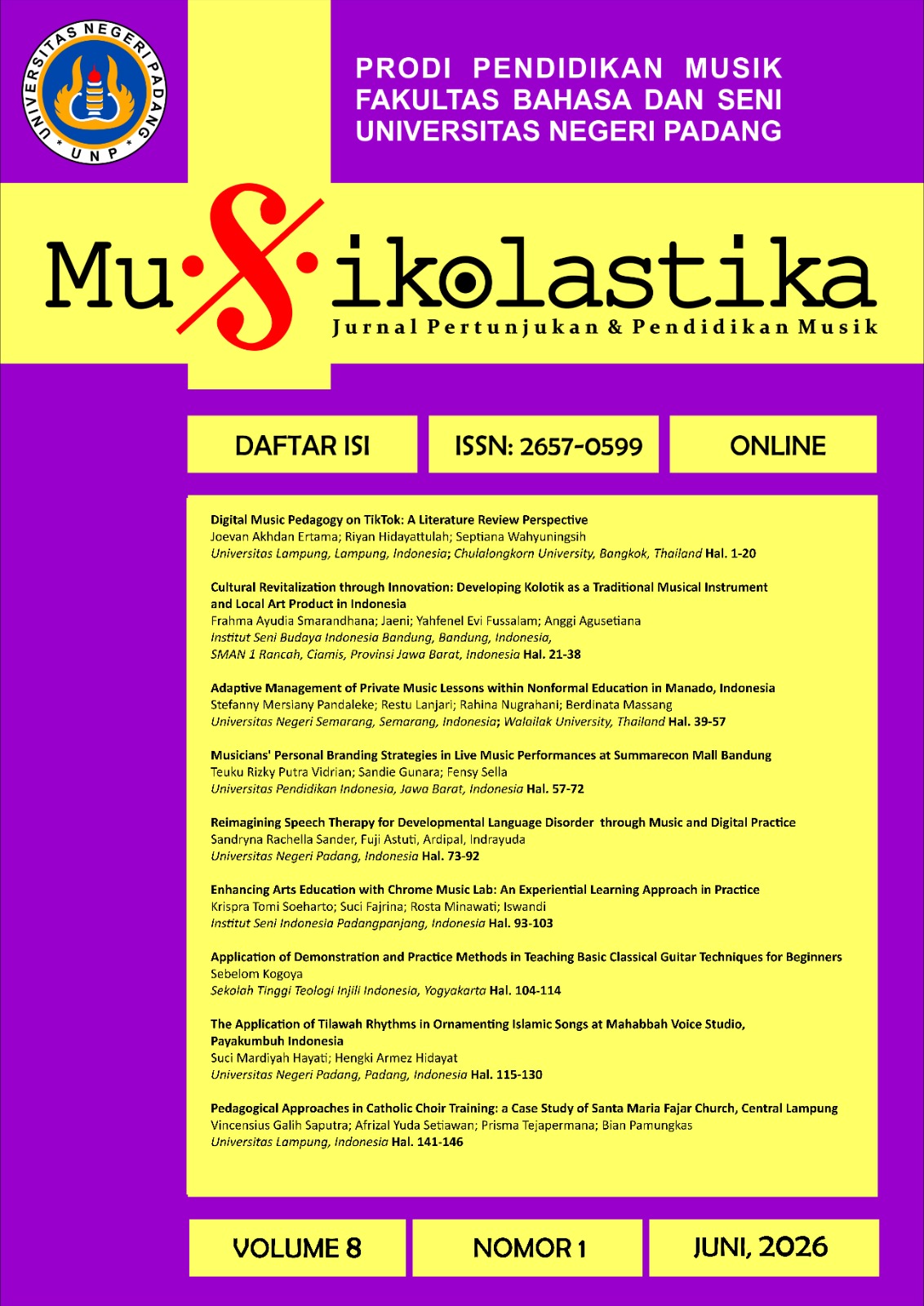
Adaptive Management of Private Music Lessons within Nonformal Education in Manado, Indonesia
DOI:
https://doi.org/10.24036/musikolastika.v8i1.355Keywords:
Private music lessons, Governance, Music education, Non-formal educationAbstract
Objective: This study aims to examine the management of private music lessons in Manado as a response to the limitations of formal education in accommodating diverse musical interests, goals, and learning backgrounds. Method: A qualitative approach with a case study design was employed, involving interviews with eight instructors, observations of learning activities, and analysis of relevant documents and social media content related to private music courses. Results and Discussion: The findings reveal that private music courses in Manado implement adaptive nonformal education management that is flexible and student-centered. Key strategies include flexibility in scheduling, location, materials, methods, and student engagement, enabling courses to respond effectively to learner diversity. Independent development of courses has fostered a management model emerging from practical experience, situational responsiveness, and pedagogical knowledge, distinguishing it from formal institutions and organized nonformal courses. Conclusion: This study confirms that private music courses serve as individualized pedagogical spaces and as adaptive nonformal arts education entities, requiring ongoing managerial reflection to maintain the quality and relevance of music learning in the contemporary era.Downloads
References
Ananda, F. S., Kurnia, S. A., Rusmana, N., & Hyangsewu, P. (2024). Eksistensi Kursus Musik Terhadap Kualitas dan Kuantitas Siswa. Journal of Education, Humaniora and Social Sciences, 7(1), 53–59. https://doi.org/10.34007/jehss.v7i1.2263
Anderson, T., Liam, R., Garrison, D. R., & Archer, W. (2001). Assessing Teaching Presence in A Computer Conferencing Context. Journal of the Asynchronous Learning Network, 5(2), 1–18.
Aoonlamai, N., & Kwangmuang, P. (2025). Integrating Digital Tools and Constructivist Learning: A Ubiquitous Learning Framework for Enhancing Creativity in Music Education. Aoonlamai and Kwangmuang BMC Psychology.
Banoe, P. (2013). Metode Kelas Musik (1st ed.). Indeks.
Bruin, L. R. De. (2021). Instrumental Music Educators in a COVID Landscape: A Reassertion of Relationality and Connection in Teaching Practice. Frontiers in Psychology, 11, 1–12. https://doi.org/10.3389/fpsyg.2020.624717
Burnard, P., & Dragovic, T. (2014). Collaborative Creativity In Instrumental Group Music Learning As A Site For Enhancing Pupil Wellbeing. Cambridge Journal of Education. https://doi.org/10.1080/0305764X.2014.934204
Butler, T. (2022). Autonomy-supportive Teaching in the Large Ensemble: Positive Outcomes for Student Motivation and Teacher Satisfaction. Music Educators Journal, 108(4), 31–36.
Cui, C. (2023). Measuring Parental Involvement as Parental Actions in Children ’ s Private Music Lessons in China. Frontiers in Psychology, 01–14. https://doi.org/10.3389/fpsyg.2022.1061765
Gaunt, H., Duffy, C., Coric, A., Delgado, I. R. G., Messas, L., Pryimenko, O., & Sveidahl, H. (2021). Musicians as “ Makers in Society ”: A Conceptual Foundation for Contemporary Professional Higher Music Education. Frontiers in Psychology, 12, 1–20. https://doi.org/10.3389/fpsyg.2021.713648
Hutapea, C. J. K. T., Widagdo, A. F., Budiman, N., & Taswadi. (2025). Pengukuran dan Evaluasi dalam Pembelajaran Musik : Kajian Teoritis dan Praktis dalam Lembaga Musik Non Formal. Musikolastika, 7(1), 55–70. https://doi.org/10.24036/musikolastika.v7i1.205
Juan-morera, B., Nadal-garcia, I., & Lopez-Casanova, B. (2023). Systematic Review of Inclusive Musical Practices in Non-Formal Educational Contexts. Education Sciences, 13(5), 1–16. https://doi.org/10.3390/ educsci13010005
Lei, S. Y., Chiu, D. K. ., Lung, M. M., & Chan, C. T. (2021). Exploring The Aids of Social Media for Musical Instrument Education. International Journal of Music Education, 39(2), 187–201. https://doi.org/10.1177/0255761420986217
Liu, Y. (2024). Evaluation of Interactive College Piano Teaching ’ s Effect Based on Artificial Intelligence Technology. International Journal of Web-Based Learning and Teaching Technologies, 19(1), 1–16. https://doi.org/10.4018/IJWLTT.335079
Ma, R., & Ma, R. (2023). Piano Education Online : Challenges and Solutions. Education and Information Technologies, 1, 1359–1372. https://doi.org/10.1007/s10639-022-11242-x
Mamahi, H. F., & Pandaleke, S. M. (2022). Strategi Kegiatan Pembelajaran Piano Klasik Bagi Anak di Jackson ’s Piano Private Learning. Clef, 3(2), 100–111.
Maragani, M., Pandaleke, S., & Wibowo, M. (2020). Strategy of Non Formal Music Education in Disruptive Era. https://doi.org/10.4108/eai.11-12-2019.2302098
Merrick, B., & Joseph, D. (2025). Confidence, Preference, and Application of ICT and Music Technology: The Changing Face of Australian Music Educators’ Practice. Research Studies in Music Education, 1–18. https://doi.org/10.1177/1321103X251361438
Miles, M. B., Huberman, A. M., & Saldana, J. (2014). Qualitative Data Analysis: A Methods Sourcebook (3rd ed.). SAGE Publications.
Nusseck, M., & Spahn, C. (2021). Musical Practice in Music Students During COVID-19 Lockdown. Frontiers in Psychology, 12, 1–8. https://doi.org/10.3389/fpsyg.2021.643177
Pandaleke, S. M., Maragani, M. H., & Mangembulude, A. L. (2025). Transformation of Non-Formal Music Education Post-Pandemic: A Case Study of Private Lessons in Manado. Atlantis Press SARL. https://doi.org/10.2991/978-2-38476-424-2_28
Riwayati, L. O., Sari, T. P., Pasaribu, A. S. Y., Anggraeni, K., & Olowoselu, A. (2025). Creative Strategies and Network Development of a Nonformal Music Education Institution in Indonesia : A Case Study of Purwa Caraka Music Studio. Musikolastika, 7(2), 220–237.
Rogers, A. (2004). Non-Formal Education: Flexible Schooling Or Participatory Education? Springer. https://doi.org/10.1007/0-387-28693-4
Ruiz-Primo, M. A. (2011). Informal Formative Assessment: The Role of Instructional Dialogues in Assessing Students’ Learning. Studies in Educational Evaluation, 37(1), 15–24. https://doi.org/10.1016/j.stueduc.2011.04.003
Sajnani, N., Mayor, C., & Tillberg-Webb, H. (2020). Aesthetic Presence : The Role of The Arts in The Education of Creative Arts Therapists in The Classroom and Online. The Arts in Psychotherapy, May. https://doi.org/10.1016/j.aip.2020.101668
Saputra, B. J. (2022). Pengelolaan Pembelajaran Musik di LKP Segno Music Course Kediri. Jurnal Pendidikan Sendratasik, 11(1), 125–139.
Schiavio, A., & Van Der Schyff, D. (2018). 4E Music Pedagogy and the Principles of Self-Organization. Behavioral Sciences, 8(72), 1–15. https://doi.org/10.3390/bs8080072
Setiyadi, B. (2020). Prosedur dan Tata Kerja Pendidikan Non Formal. Jurnal Pendidikan Luar Sekolah, 4(2), 12–19. https://doi.org/10.19184/jlc.v4i2.21288
Storsve, G. (2024). Formal , Informal , and Non-formal Learning as Analytic Categories for Research in Music Education. International Journal of Music Education. https://doi.org/10.1177/02557614241250035
Sulistyowati, R. (2024). Manajemen Pendidikan Musik: Pengalaman dan Persepsi Guru Musik SMA di Kota Palangka Raya. Musikolastika, 6(1), 13–26. https://doi.org/10.24036/musikolastika.v6i1.140
Váradi, J., Józsa, G., Fodor, A. S., Molnár-Tamus, V., & Szűcs, T. (2023). Investigating Music Teachers’ ICT Skills and Technical Possibilities in the Field of Online Music Education During the COVID-19 Pandemic. Heliyon, 9(6). https://doi.org/10.1016/j.heliyon.2023.e16463
Wiratmoko, C., Zain, M. A., Farida, L., & Wu, S. (2025). TikTok as an Informal Music Learning Platform: An Analysis of the Impact of Music Extracurricular Activities on Students of SMK 1 Pancasila Ambulu , Indonesia. Virtuoso: Jurnal Pengkajian Dan Penciptaan Musik, 8(2), 105–123. https://doi.org/10.26740/vt.v8n2.p105-123
Xu, S., & Li, D. (2025). Autonomy-supportive Music Teaching , Collective Learning, Flow, and Music Students ’ well-being: A Mediational Model. Acta Psychologica, 254(January), 104827. https://doi.org/10.1016/j.actpsy.2025.104827
Yusuf, A. M. (2021). Metode Penelitian Kuantitatif, Kualitatif & Penelitian Gabungan (6th ed.). Kencana.
Zhang, H. (2025). Artificial Intelligence in Music Education : A Scoping Review of Practices , Strategies , and Challenges. Journal of Advanced Research in Education, 4(5), 69–82. https://doi.org/10.56397/JARE.2025.09.09
Downloads
Published
How to Cite
Issue
Section
License
Copyright (c) 2026 Stefanny Mersiany Pandaleke, Restu Lanjari, Rahina Nugrahani, Berdinata Massang

This work is licensed under a Creative Commons Attribution-NonCommercial-ShareAlike 4.0 International License.
Authors who publish with this journal agree to the following terms: Authors retain copyright and grant the journal right of first publication with the work simultaneously licensed under a Creative Commons Attribution-ShareAlike 4.0 International License. that allows others to share the work with an acknowledgement of the work's authorship and initial publication in this journal.
Authors are able to enter into separate, additional contractual arrangements for the non-exclusive distribution of the journal's published version of the work (e.g., post it to an institutional repository or publish it in a book), with an acknowledgement of its initial publication in this journal. Authors are permitted and encouraged to post their work online (e.g., in institutional repositories or on their website) prior to and during the submission process, as it can lead to productive exchanges, as well as earlier and greater citation of published work (See The Effect of Open Access).

This work is licensed under a Creative Commons Attribution-ShareAlike 4.0 International License.
.png)




1.png)