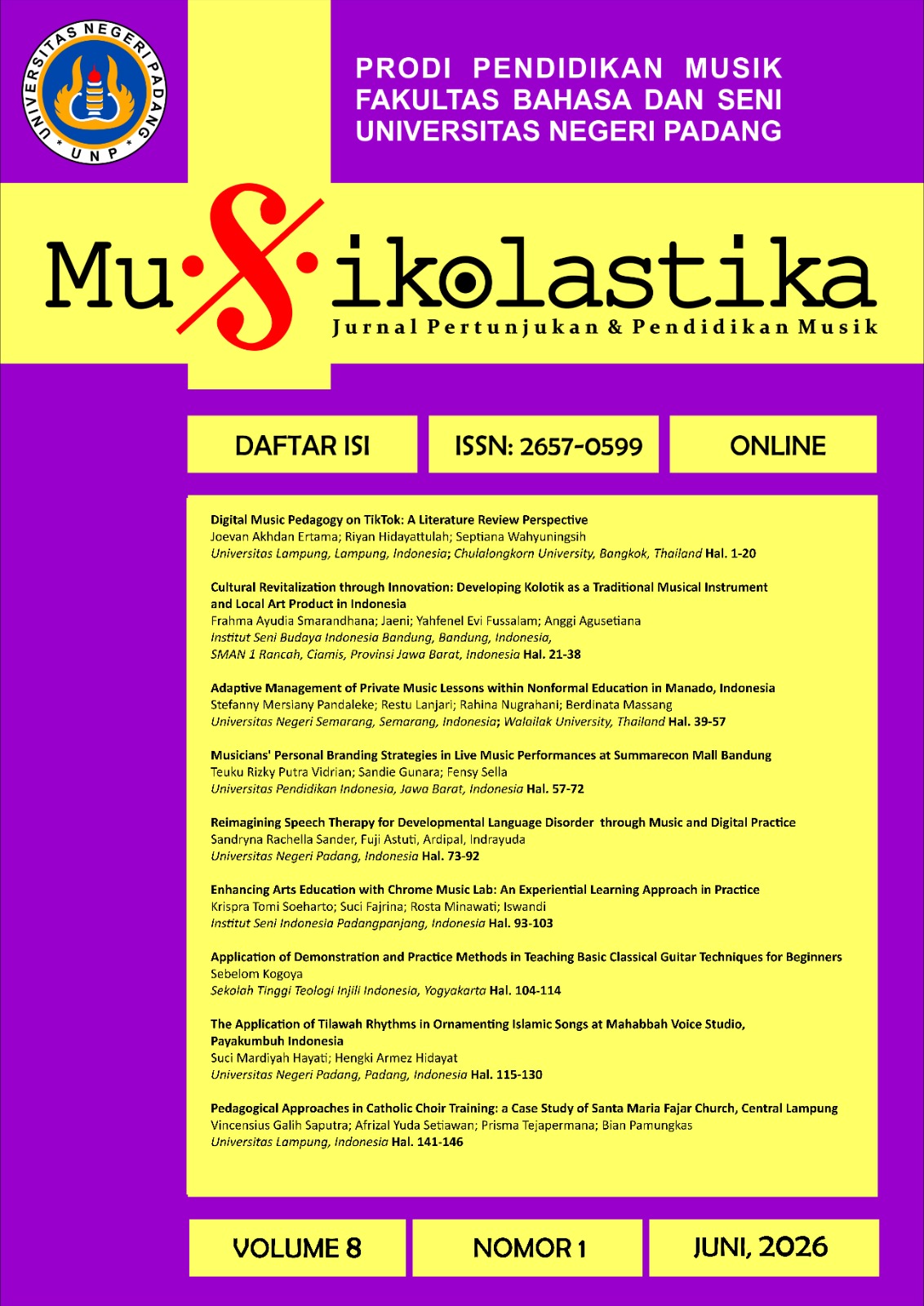
Cultural Revitalization through Innovation: Developing Kolotik as a Traditional Musical Instrument and Local Art Product in Indonesia
DOI:
https://doi.org/10.24036/musikolastika.v8i1.353Keywords:
Kolotik, innovation, develop, local culture, preservation, musical notationAbstract
Objective: This study aims to analyze the innovation process in the development of the Kolotik musical instrument as a strategy for revitalizing traditional arts while strengthening Ciamis’s local art products. Method: A descriptive qualitative method with an arts ethnography approach was employed and conducted in Cimaragas District, Ciamis Regency, through participatory observation of the production and use of Kolotik, in-depth interviews with craftsmen, artists, community leaders, and arts educators, as well as visual documentation and field notes; data were analyzed through reduction, presentation, and conclusion drawing using source and technique triangulation. Results and Discussion: The findings indicate that Kolotik innovation occurs across four main domains: (1) the transformation of form and function through the development of size, color, and ornamentation, along with the expansion of functions from a traditional rhythmic instrument into an applied art product with aesthetic and economic value; (2) the development of numerical notation and simple scores as documentation media to transform oral transmission into more systematic learning, including applications to regional songs such as Bubuy Bulan and Manuk Dadali; (3) the strengthening of sustainability through the roles of community and educational institutions via training, performances, festivals, and the integration of arts learning based on local wisdom; and (4) the preservation of Kolotik’s cultural and philosophical values, such as harmony, togetherness, and human nature balance as a Sundanese identity that remains relevant amid the dynamics of modern society. Conclusion: Revitalization-based innovation enables Kolotik not only to endure as cultural heritage but also to evolve as an adaptive and functional learning instrument and local art product that sustainably reinforces Ciamis’s cultural identity.
Downloads
References
Adiwisastra, M. F., Iskandar, Y., Safitri, L. J., Fauziah, A. Z., Mujahidillah, V. A., & Sulaeman, S. (2023). Pelestarian Potensi Alat Musik Kolotik Sebagai Ikon Desa Beber Ciamis. Abditeknika Jurnal Pengabdian Masyarakat, 3(1), 9–16. https://doi.org/10.31294/abditeknika.v3i1.1854
Andiansyah, A., Vivian, Y. I., & Putra, B. A. (2025). Revitalisasi kesenian Mamanda Kutai oleh Sanggar Seni Budaya Kutai Bensamar dalam menguatkan branding Kampong Adat Tuha. In Ilmu Budaya: Jurnal Bahasa, Sastra, Seni, dan Budaya (Vol. 9, Issue 3, p. 209). Universitas Mulawarman. https://doi.org/10.30872/jbssb.v9i3.23017
Brewer, J. (2000). Ethnography as method and methodology. In Ethnography.
Firmansyah, S. L. (2024). Pengaruh Kecepatan Inovasi Terhadap Daya Saing UMK: Peran Mediasi Knowledge Creation. Universitas Islam Indonesia.
Heldisari, H. P. (2020). Efektivitas Metode Eurhythmic Dalcroze Terhadap Kemampuan Membaca Ritmis Notasi Musik. Jurnal Imiah Pendidikan Dan Pembelajaran, 4(3), 468–478. https://doi.org/10.23887/jipp.v4i3.28223
Herlambang, Y. T., & Dwiningrum, S. I. A. (2020). Reorientasi pendidikan multikultural dalam konteks keIndonesiaan. In Jurnal Pembangunan Pendidikan: Fondasi dan Aplikasi (Vol. 8, Issue 1, pp. 60–66). Universitas Negeri Yogyakarta. https://doi.org/10.21831/jppfa.v8i1.29915
Jose, A. M. Da. (2024). Pemanfaatan Teknologi Digital dalam Branding Musik di Media Sosial Menjadi Media Pembelajaran. In JPGENUS: Jurnal Pendidikan Generasi Nusantara (Vol. 2, Issue 2, pp. 186–194). Yayasan Umar Abdul Gani Bima. https://doi.org/10.61787/b7ra9984
Nuridayu, N., Kiya, A., & Wahyuni, I. W. (2020). Pengembangan Motorik Kasar Anak Usia Dini Melalui Permainan Gerakan Binatang. In As-Sibyan: Jurnal Pendidikan Anak Usia Dini (Vol. 5, Issue 2, pp. 107–120). Lembaga Penelitian dan Pengabdian kepada Masyarakat (LP2M) Universitas Islam Negeri (UIN) Sultan Maulana Hasanuddin Banten. https://doi.org/10.32678/as-sibyan.v5i2.2701
Oktovan, R. N., Suryamah, D., & Dwiatmini, S. (2021). Pewarisan Budaya Dalam Kesenian Bringbrung Di Kelurahan Ledeng, Kecamatan Cidadap Hilir, Kota Bandung. In Jurnal Budaya Etnika (Vol. 4, Issue 2). Institut Seni Budaya Indonesia Bandung. https://doi.org/10.26742/be.v4i2.1566
Parera, T. P. (2023). DINAMIKA KELOMPOK SENI DALAM USAHA PELESTARIAN SENI TRADISI (STUDI TERHADAP KELOMPOK SENI TEATER MATA ENDE FLORES). In PENSI : Jurnal Ilmiah Pendidikan Seni (Vol. 3, Issue 1, pp. 73–83). Fakultas Seni Pertunjukan, Institut Seni Indonesia Denpasar. https://doi.org/10.59997/pensi.v3i1.2224
Permadi, Y., & Delisma, O. (2025). KIAT-KIAT DALAM MENUMBUHKAN CINTA BUDAYA SUNDA DI KALANGAN GENERASI Z. In Jurnal Kajian Budaya dan Humaniora (Vol. 7, Issue 3, pp. 238–242). Lintas Budaya Nusantara. https://doi.org/10.61296/jkbh.v7i3.383
Putri, T. E., Anggriani, K., & Vinalti, G. (2025). PENDAMPINGAN DIGITALISASI ASET SENI DAN BUDAYA BENGKULU DI MUSEUM BDARU SEBAGAI UPAYA TRANSFORMASI DIGITAL DAN PELESTARIAN BUDAYA LOKAL. In Jurnal Abdi Insani (Vol. 12, Issue 9, pp. 4996–5005). Universitas Mataram. https://doi.org/10.29303/abdiinsani.v12i9.3108
Putri, T. F. D., Putra, A., & Palenti, C. D. (2025). Prinsip Andragogi dalam Pembelajaran Kesenian Kuda Lumping di Desa Pal Tiga Puluh Kecamatan Lais Kabupaten Bengkulu Utara. In Journal of Millennial Community (Vol. 7, Issue 2, pp. 123–132). State University of Medan. https://doi.org/10.24114/jmic.v7i2.65029
Rusdewanti, P. P., & Gafur, A. (2014). Pengembangan Media Pembelajaran Interaktif Seni Musik untuk Siswa SMP. Jurnal Inovasi Teknologi Pendidikan, 1(2), 153–164. https://doi.org/10.21831/tp.v1i2.2526
Simatupang, G. R. L. L. (2019). Play and Display: Dua Moda Pergelaran Reyog Ponorogo di Jawa Timur. Porgram Studi Pengkajian Seni Pertunjukan dan Seni Rupa, Universitas Gadjah Mada Yogyakarta.
Sinaga, F. S. S., Winangsit, E., & Putra, A. D. (2021). Pendidikan, Seni, dan Budaya: Entitas Lokal dalam Peradaban Manusia Masa Kini. Virtuoso: Jurnal Pengkajian Dan Penciptaan Musik, 4(2), 104–110. https://doi.org/10.26740/vt.v4n2.p104-110
Sinaga, S. S., Mumpuni, R. A., Sinaga, F. S. S., Aesijah, S., & Nugroho, A. E. (2025). Innovating Music Education Through Digital Platforms: A Mixed-Methods Approach to Enhancing Cultural Awareness. Korean Journal of Research in Music Education, 54(2), 139–160. https://doi.org/10.30775/KMES.54.2.139
Solikhah, N. (2023). EDUKASI EKSISTENSI DAN KEBERLANJUTAN KAWASAN BERSEJARAH UNTUK GENERASI Z. In Jurnal Bakti Masyarakat Indonesia (Vol. 5, Issue 3). Universitas Tarumanagara. https://doi.org/10.24912/jbmi.v5i3.22713
Sumiati, L., & Budi, D. S. U. (2024). REVITALISASI SENI TRADISI DI RANCAKALONG SUMEDANG JAWA BARAT. In Abdi Seni (Vol. 15, Issue 1). Institut Seni Indonesia Surakarta. https://doi.org/10.33153/abdiseni.v15i1.5462
Supanggah, R. (1995). Etnomusikologi. Yayasan Betang Budaya.
Supanggah, R. (2003). Campur sari: A reflection. Asian Music, 34(2), 1–20.
Susanto, S. (2020). Kajian Misi Kontekstual Terhadap Spiritualitas Dalam Budaya: Budaya Mabak Sabek Di Dusun Gun Jemak - Kalbar. Center for Open Science. https://doi.org/10.31219/osf.io/tbuj4
Trijayanto, S., Karsiwan, & Sari, L. R. (2025). Gamelan sebagai cermin identitas budaya. In Panggung (Vol. 35, Issue 4, pp. 638–648). Institut Seni Budaya Indonesia Bandung. https://doi.org/10.26742/panggung.v35i4.3633
Yuwono, A. (2025). The resilience of traditional communities in the modern era: a case study of kentrung art in Java, Indonesia. Cogent Arts and Humanities, 12(1). https://doi.org/10.1080/23311983.2025.2469464
Downloads
Published
How to Cite
Issue
Section
License
Copyright (c) 2026 Frahma Ayudia Smarandhana, Jaeni, Yahfenel Evi Fussalam

This work is licensed under a Creative Commons Attribution-NonCommercial-ShareAlike 4.0 International License.
Authors who publish with this journal agree to the following terms: Authors retain copyright and grant the journal right of first publication with the work simultaneously licensed under a Creative Commons Attribution-ShareAlike 4.0 International License. that allows others to share the work with an acknowledgement of the work's authorship and initial publication in this journal.
Authors are able to enter into separate, additional contractual arrangements for the non-exclusive distribution of the journal's published version of the work (e.g., post it to an institutional repository or publish it in a book), with an acknowledgement of its initial publication in this journal. Authors are permitted and encouraged to post their work online (e.g., in institutional repositories or on their website) prior to and during the submission process, as it can lead to productive exchanges, as well as earlier and greater citation of published work (See The Effect of Open Access).

This work is licensed under a Creative Commons Attribution-ShareAlike 4.0 International License.
.png)




1.png)