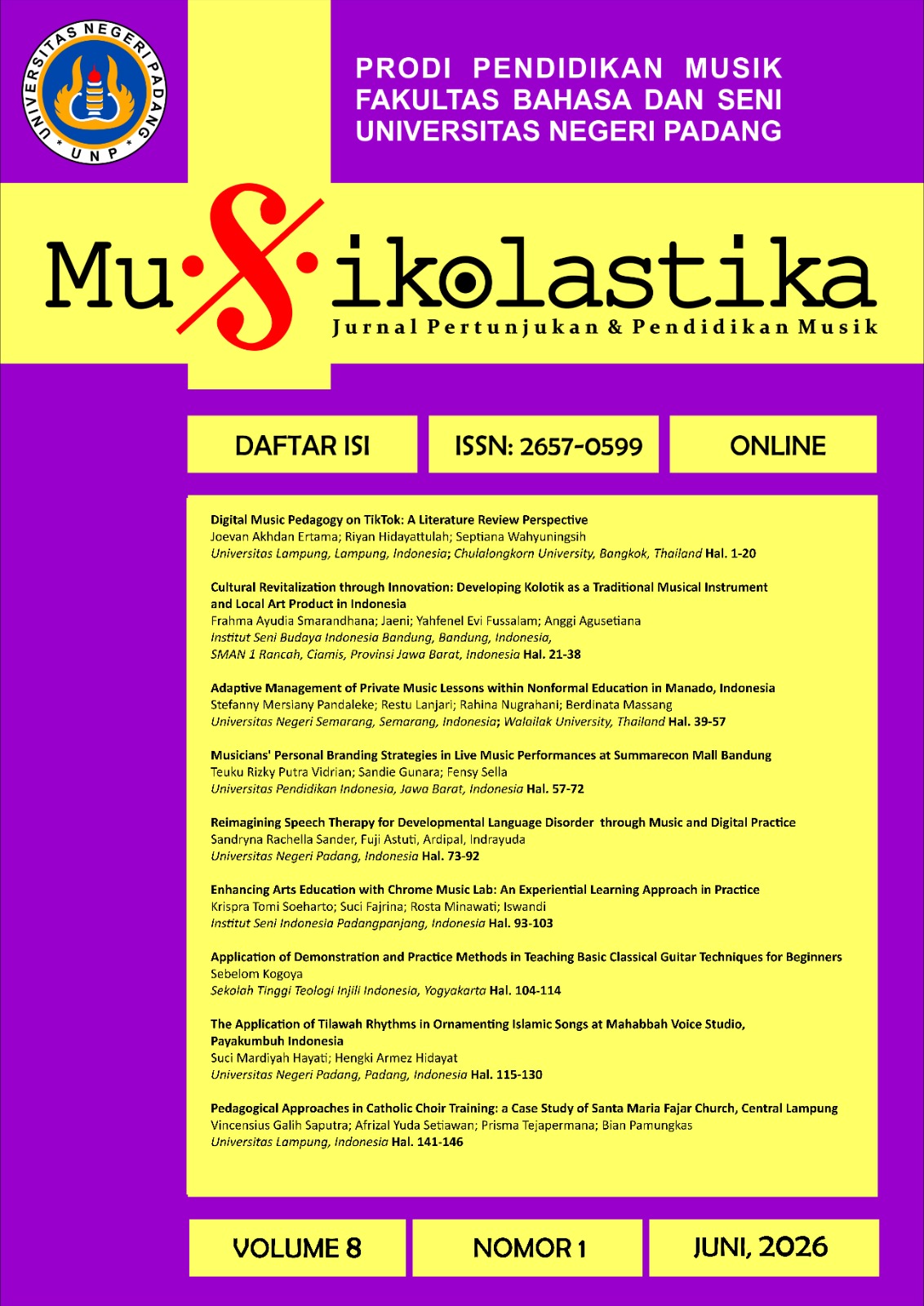
Digital Music Pedagogy on TikTok: A Literature Review Perspective
DOI:
https://doi.org/10.24036/musikolastika.v8i1.324Keywords:
Tiktok, music learning, literature review, digital musicAbstract
Objective: This study aims to analyze the behaviors of TikTok users in music learning in today’s fast-paced and interactive digital era, considering that TikTok is widely used both as a source of entertainment and information, leading to diverse and unique patterns of user creativity that influence the music learning process. Method: The research employs a literature review by examining relevant scholarly journals and conducting direct observations of phenomena on the TikTok platform, including analyses of short videos, user comments, collaborations, and the dissemination of music content. Collected data were qualitatively analyzed to identify learning behavior patterns both at the individual and social levels. Results and Discussion: Findings reveal that TikTok provides an easily accessible space for expression and creativity, allowing users to learn music independently while also engaging in social interactions. Learning occurs not only individually but also through discussion, clarification, and collective evaluation of music content circulating on the platform, fostering collaboration, innovation, and deeper understanding. Conclusion: This study confirms that TikTok is not merely an entertainment platform but also an effective tool for music learning in the digital era, supporting both personal and collaborative learning while expanding access, creativity, and user engagement in contemporary music education practices.Downloads
References
Asgar, A., Idris, A. H., Octaviani, R., Habesia, H., & Rillan, Y. (2025). Analisis Pengalaman Mahasiswa dalam Menggunakan TikTok sebagai Media Pembelajaran. Jurnal Pendidikan Dan Pembelajaran Indonesia (JPPI), 5(2), 743–761. https://doi.org/10.53299/jppi.v5i2.1080
Aubryla, H., & Ratnawati, V. (2023). Strategi Mengelola Penggunaan Tiktok Agar Tidak Mempengaruhi Konsentrasi Belajar Siswa. Prosiding SEMDIKJAR (Seminar Nasional Pendidikan Dan Pembelajaran),. https://doi.org/10.29407/wvt7qv89
Awwalin, I. N., & Syaipudin, L. (2025). Pemanfaatan Media Sosial Bagi Pelajar (Studi Literatur Pengguna TikTok). Jurnal Ilmiah Pengayaan Pembelajaran Dan Pendidikan Islam, Vol. 2 No. 1, 90–98.
Ayomi, C. P. (2025). Implementasi Metode Kodaly pada Ritme Lagu Viral Tik-Tok Velocity Hiedajarwo, Menggunakan Clap Hand sebagai Peningkatan Solfeggio di Kalangan Gen Alpha. ResearchGate. https://www.researchgate.net/publication/390313443_Implementasi_Metode_Kodaly_pada_Ritme_Lagu_Viral_Tik-Tok_Velocity_Hiedajarwo_Menggunakan_Clap_Hand_sebagai_Peningkatan_Solfeggio_di_Kalangan_Gen_Alpha
De Moya Martínez, M. D. V., Segura Tornero, A., & González Amo, G. (2024). Music and Tiktok in Social Sciences A Didactics of Brain Languages. VISUAL REVIEW. International Visual Culture Review / Revista Internacional de Cultura Visual, 16(1), 179–195. https://doi.org/10.62161/revvisual.v16.5175
Devi, A. A. (2022). Pemanfaatan Aplikasi Tiktok Sebagai Media Pembelajaran. Epistema, 3(1), 10–17. https://doi.org/10.21831/ep.v3i1.40990
Fitri Fajriani, Nabila Nur Aprilia, Izhar Harahap, & Sri Mulyeni. (2024). Penggunaan Media Sosial Tiktok dalam Proses Pembelajaran. Mutiara : Jurnal Penelitian Dan Karya Ilmiah, 3(1), 96–104. https://doi.org/10.59059/mutiara.v3i1.1962
Halimi, M. M. A. M., & Mazlan, C. A. N. (2022). Needs Analysis of Using Tiktok Applications as an Alternative in Music Teaching and Learning. Musikolastika: Jurnal Pertunjukan Dan Pendidikan Musik, 4(2), 115–122. https://doi.org/10.24036/musikolastika.v4i2.90
Herdiati, D., Atmaji, D. D., Andriyanto, R. M. A., & Saputra, D. N. (2021a). Pemanfaatan Aplikasi Tiktok Sebagai Media Pembelajaran Musik di SMAN 1 Muara Enim, Sumatera Selatan. Virtuoso: Jurnal Pengkajian Dan Penciptaan Musik, 4(2), 111–119. https://doi.org/10.26740/vt.v4n2.p111-119
Ihzadila, A. M., & Sukmayadi, Y. (2024). Utilization of the TikTok Application as Multimedia in Violin Learning. In J. Masunah, T. Narawati, Y. Sukmayadi, Z. S. Soeteja, T. Nugraheni, R. Milyartini, & A. Budiman (Eds.), Proceedings of the Fifth International Conference on Arts and Design Education (ICADE 2022) (Vol. 771, pp. 310–316). Atlantis Press SARL. https://doi.org/10.2991/978-2-38476-100-5_43
Jenkins, H. (2006). Convergence Culture. NYU Press. https://books.google.co.id/books/about/Convergence_Culture.html?hl=id&id=HZgUCgAAQBAJ&redir_esc=y
Liedfray, T., Waani, F. J., & Lasut, J. J. (2022). Peran Media Sosial Dalam Mempererat Interaksi Antar Keluarga di Desa Esandom Kecamatan Tombatu Timur Kabupaten Minahasa Tenggara. JURNAL ILMIAH SOCIETY. https://ejournal.unsrat.ac.id/v3/index.php/jurnalilmiahsociety/article/view/38118/34843
Listiarini, Y. (2024). EFEKTIVITAS PEMBELAJARAN MUSIK TERHADAP PENGEMBANGAN KREATIVITAS SISWA JENJANG PENDIDIKAN SEKOLAH DASAR DI KABUPATEN KUBU RAYA. TACET Jurnal Pendidikan Dan Kajian Seni, 3(2), 74–81. https://doi.org/10.26418/tacet.v3i2.87220
Madoni, R. A. & Marzam. (2024). Effectiveness of Local Music Learning Using Audio Visual Media. Avant-Garde: Jurnal Ilmiah Pendidikan Seni Pertunjukan, 2(2), 238–245. https://doi.org/10.24036/ag.v2i2.124
Manurung, E. N., Purwati, P. D., Andaryani, E. T., Subali, B., & Avrilianda, D. (2025). Pengaruh Aplikasi Tiktok pada Aspek Perkembangan Sosial-emosional Anak Sekolah Dasar. Jurnal Educatio FKIP UNMA. https://www.ejournal.unma.ac.id/index.php/educatio/article/view/12644
McLuhan, M. (1964). Understanding Media. The MIT Press Cambridge, Massachusetts London, England. https://books.google.co.id/books?id=1LdoAAAAIAAJ&hl=id&source=gbs_book_other_versions_r&cad=1
Miksza, P., Shaw, J. T., Richerme, L. K., Hash, P. M., & Hodges, D. A. (2023). Music Education Research: An Introduction. Oxford University Press.
Montag, C., Yang, H., & Elhai, J. D. (2021). On the Psychology of TikTok Use: A First Glimpse From Empirical Findings. Frontiers in Public Health, 9, 641673. https://doi.org/10.3389/fpubh.2021.641673
Oktariani, D. (2023). PEMANFAATAN APLIKASI TIKTOK SEBAGAI MEDIA PEMBELAJARAN SENI TARI TRADISI NUSANTARA PADA REMAJA. Jurnal Pendidikan Sosiologi Dan Humaniora, 13(2), 907. https://doi.org/10.26418/j-psh.v13i2.64172
Putri, L. S., Tasya, L., Qistina, N. I., & Lubis, H. Z. (2024). Pentingnya Pendidikan Musik dalam Pembelajaran Anak Usia Dini di TK Ananda. Jurnal Pendidikan Tambusai, Vol 8, 223–231.
Putri, R. P. (2021). Tiktok as an Online Learning Media During a Pandemic: Case Study: Dance Creativity Course. 6th International Conference on Education & Social Sciences (ICESS 2021), Semarang, Indonesia. https://doi.org/10.2991/assehr.k.210918.052
Ramdani, N. S., Nugraha, H., & Hadiapurwa, A. (2021). POTENSI PEMANFAATAN MEDIA SOSIAL TIKTOK SEBAGAI MEDIA PEMBELAJARAN DALAM PEMBELAJARAN DARING. Akademika, 10(02), 425–436. https://doi.org/10.34005/akademika.v10i02.1406
Samosir, H. T. G. (2023). Aplikasi Tiktok: Media Pengumpulan Tugas Pembelajaran Seni Musik Mahasiswa PGSD. Jurnal Pendidikan Dan Konseling, 4690–4697.
Sun, J., Siripala, W., & Yang, F. (2025). The influence of social media platforms via TikTok on piano teaching to students. African Educational Research Journal, African Educational Research Journal Vol. 13(2). https://doi.org/10.30918/AERJ.132.25.017
Suryaningsih, A. (2020). DAMPAK MEDIA SOSIAL TERHADAP PRESTASI BELAJAR PESERTA DIDIK. EDUSAINTEK : JURNAL PENDIDIKAN, SAINS DAN TEKNOLOGI, 7(1), 1–10. https://doi.org/10.47668/edusaintek.v7i1.45
Suwoto, A. L. B., Wijayanti, E. T., Maharani, N. A., Zahrohmah, A. F., & Dwi A, B. P. (2025). Aplikasi Terapi Musik JJ TikTok: Inovasi Membangun Percaya Diri Gen Z di SMPN 1 Semen Kediri. PROSIDINGSEMINAR PENDIDIKAN DAN PENGAJARAN (SEMDIKJAR) 8. https://doi.org/10.29407/brnw4m57
Zeng, J., Abidin, C., & Schäfer, M. S. (2021). Research Perspectives on TikTok and Its Legacy Apps. International Journal of Communication15(2021), 3161–3172, Vol. 15 (2021), 3161–3172.
Downloads
Published
How to Cite
Issue
Section
License
Copyright (c) 2026 Joevan Akhdan Ertama, Riyan Hidayatullah, Septiana Wahyuningsih

This work is licensed under a Creative Commons Attribution-ShareAlike 4.0 International License.
Authors who publish with this journal agree to the following terms: Authors retain copyright and grant the journal right of first publication with the work simultaneously licensed under a Creative Commons Attribution-ShareAlike 4.0 International License. that allows others to share the work with an acknowledgement of the work's authorship and initial publication in this journal.
Authors are able to enter into separate, additional contractual arrangements for the non-exclusive distribution of the journal's published version of the work (e.g., post it to an institutional repository or publish it in a book), with an acknowledgement of its initial publication in this journal. Authors are permitted and encouraged to post their work online (e.g., in institutional repositories or on their website) prior to and during the submission process, as it can lead to productive exchanges, as well as earlier and greater citation of published work (See The Effect of Open Access).

This work is licensed under a Creative Commons Attribution-ShareAlike 4.0 International License.
.png)




1.png)